The lift
College Avenue between Ferguson and Erwin streets: every brick taken up in September 2025, and bricks back down in front of Plaza Tower on March 2, 2026.
1September 2025
Taken up
Crews took up every brick on College Avenue between Ferguson and Erwin streets for the Downtown Improvement Project.1
The city's rule, as reported in 2015: because the old bricks are a finite resource, utility crews lift them one by one and stack them for city workers to relay.2
Every lift costs brick
“This is a young man’s job,” the city’s streets operations manager, Robin Smart, said in 2015: manual labor, most of it “with picks and shovels, and on your knees laying bricks.”9
- 10%
of each brick is lost every time it is disturbed, Smart estimated in 2015, and how long the stockpile lasts depends on how many utility cuts and infrastructure projects there are.10
About a tenth, every time. - $7–$17
a square foot to repair a brick street in 2015, depending on what had to be done underneath, against about $1 for an asphalt overlay and about 35 cents for a seal coat. By mid-August that year the city had spent about $47,000 on brick repairs.11
Cost a square foot, 2015 - Brick repair$7 to $17
- Asphalt overlayabout $1
- Seal coatabout 35¢
- 3
people on the city’s brick crew in 2015, repairing the streets by hand.2
The city gave two main reasons for the work that year: utility cuts, and “level ups” that flatten sagging stretches.12 Crews relaid the bricks on fresh sand and sealed them with concrete dyed in the city’s own hopper, so a repaired street would not look like a patchwork quilt.13
- 26,000
bricks given to the city in 2014 by the Tyler Morning Telegraph, dug up while it built a parking lot on Erwin Street, where a street once ran.14
A year without a brick crew
Budget cuts froze the city’s Brick Street Operator job, and the streets went a year without maintenance. In September KLTV reported that Mayor Don Warren had made a three-man brick crew a priority, that the job would reopen on October 1, and that the city had another $350,000 with a contractor for larger rebuilds.15
In July the council had approved putting brick back into 43 utility cuts patched with asphalt, nearly $100,000 of work.16
“They are a part of our culture and our heritage and when people come to Tyler, one of the things they really look at are our brick streets.”
The 2023 list
- sites
- 33
- square feet
- 21,355
- the contract
- $873,961
The city’s repair list for 2023 has 33 sites with an area to repair, 21,355 square feet in all; the largest, 2,750 square feet, is at 902 South College Avenue, where Dobbs crosses College.18 The council gave the work to Crown Civil Construction in July.19
It also takes in North Bois d’Arc at West Cedar, North Border north of West Bow, Goodman Street, East Oakwood and South Oakland south of East Mulberry.20
The bricks are laid and leveled by hand, on a layer of sand. Streets Manager Sara McCracken called the project “an essential step towards restoring the City’s historical neighborhoods brick by brick.”21 Not everyone agreed: KETK found residents who said the streets keep Tyler’s history, and others who said the bricks should be picked up and packed away.22
Downtown, 2025 to 2026
Erwin and Ferguson streets in May 2016, nine years before the downtown rebuild began.4
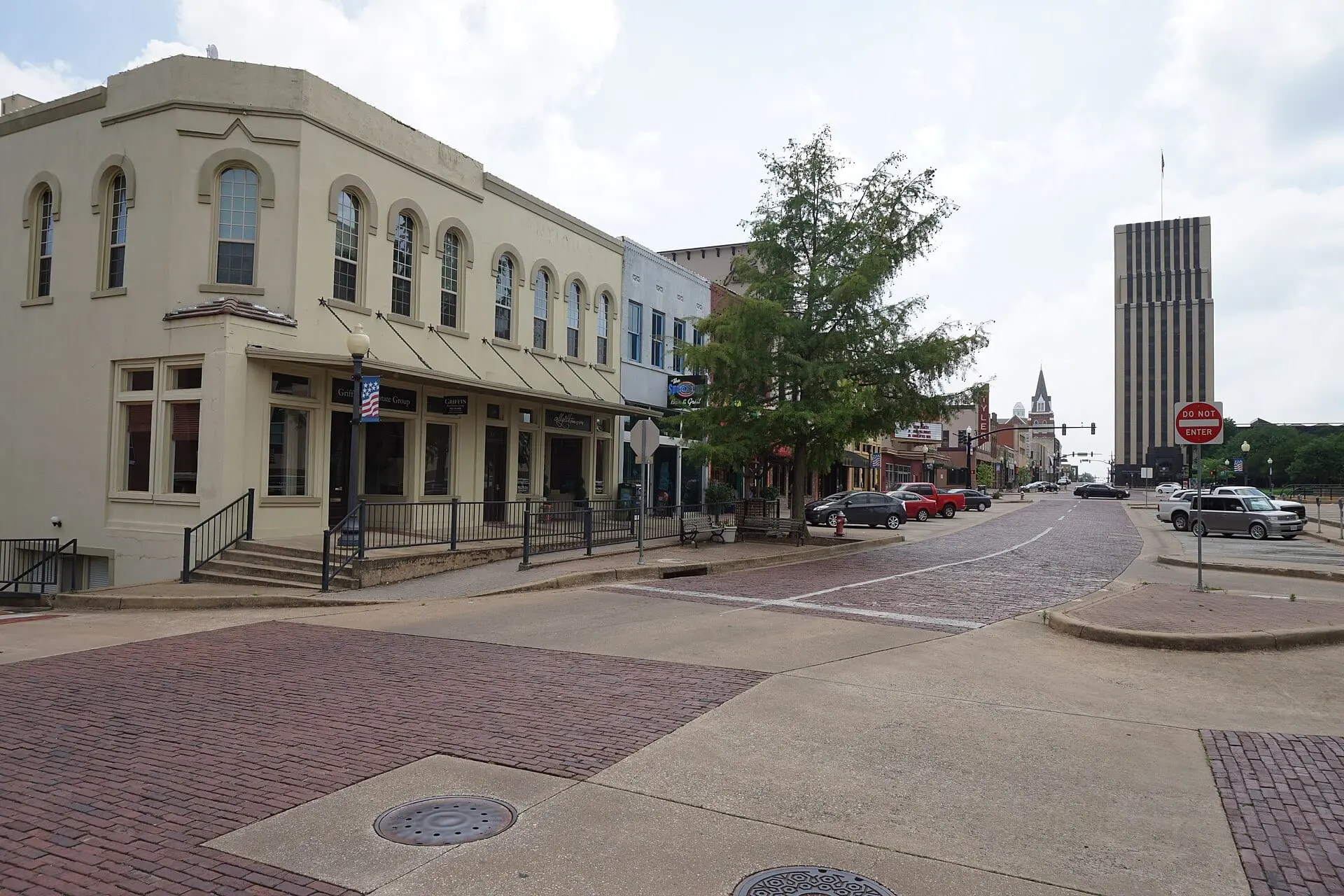
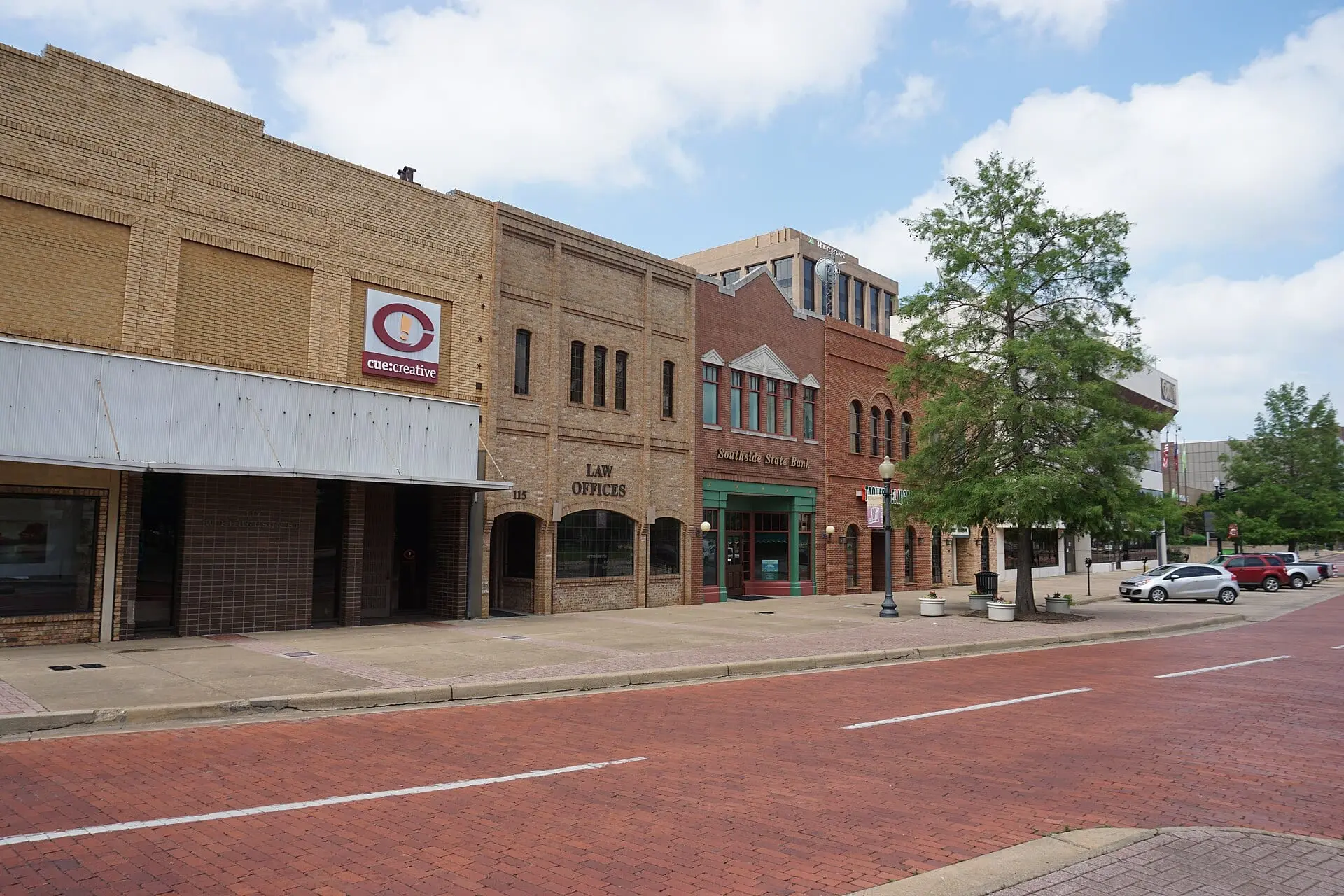
- Sept. 2025
One by one. As crews lifted College Avenue’s bricks, Main Street director Amber Varona said the street would get a level base and concrete headers to mark the lanes and keep the bricks from moving.23 There were four types of brick in the project area, she said, and they would be kept apart; in 2015 the city had counted three types across its streets, none still made.24
- Sept. 20
Free bricks. At 7 a.m. on a Saturday, bricks from the project were given away at Broadway and Ferguson, and all were gone in about an hour. KLTV reported that they were made in Missouri, without saying how it knew; the National Register documents name the Thurber, Mineral Wells and Tyler brick companies.25 Jesse Wilson of the contractor, Precision Civil, called it “a very bittersweet project,” and kept a brick himself.26
- Oct. 22
The sewer line. The council approved a $1,473,686 contract with Crown Civil Construction to take up the bricks along a downtown sewer project crossing Elm, College and Woldert and lay temporary asphalt. The city said the cleaned bricks would go back, except those from Elm between Fannin and College, long under asphalt, which would be stockpiled while that stretch got permanent asphalt.27
- Nov. 2025
West Elm. Crews were taking up the bricks on West Elm Street between College and Broadway and laying temporary asphalt, with Bois D’Arc Avenue next.28
- March 2026
- April 2026
What lay under them. Defending the project’s delays, Mayor Don Warren said: “When you dig down under bricks that have been there 100 years, you’re going to come across stuff you’re not expecting.”29
- June 3
Open. Rebuilt College Avenue and Erwin Street reopened to two-way traffic.8
- July 2026
West Ferguson. After new water and sewer lines and a concrete base, crews began setting the old bricks back on part of West Ferguson Street.30
- $25.6 million
The whole rebuild, city and county, of downtown’s streets, utilities and square, including $10.7 million in ARPA funds; as of September 2026 it was expected to finish by April 2028.5
Notes
Every source is listed on Sources and methods.
Note 1. In September 2025, crews took up every brick on College Avenue between Ferguson and Erwin streets for the Downtown Improvement Project, palletized and stored them.
Note 2. Because the old bricks are a finite resource, the city requires utility crews to lift them one by one and stack them for city workers to relay, and as of 2015 a dedicated three-person city crew repaired brick streets by hand.
Note 3. As of 2015, the city counted nearly 14 miles (13.8) of brick streets made of about 12.6 million bricks, of three types no longer manufactured, so repairs draw on stockpiled bricks. Counts differ by year and source: about 20 miles of brick by about 1942 and about seven in 2000–03 (National Register documents), about 15 in 2013 (a city planner), 13 in 2023 (the city).
- Tyler Morning Telegraph, 2015-08-17: Tyler's 13.8 Miles of Brick Streets Give East Texas Town Historic Charm tylerpaper.com
- Tyler Morning Telegraph, 2025-09-17: Crews Remove Historic Bricks on College Avenue to Make Way for Infrastructure Work in Downtown Tyler tylerpaper.com
- Historic Tyler: Brick Streets Neighborhood Historic District historictyler.org
Note 4. The Downtown Improvement Project began in September 2025, converts the streets around the square to two-way traffic, rebuilds the square with green space (due by May 2027) and restrooms, and later adds roundabouts on South Broadway starting November 2027.
- Tyler Morning Telegraph, 2026-04-29: Tyler Mayor Don Warren Discusses Downtown Project Timeline Funding and Businesses on the Square tylerpaper.com
- Tyler Morning Telegraph, 2026-09-07: Tyler's Downtown Improvement Project Work Shifts to Broadway Avenue tylerpaper.com
- KLTV, 2026-03-02: Downtown Tyler Improvements Continue Bricks Returned College Avenue kltv.com
Note 5. Downtown Tyler is in the middle of a $25.6 million city-county rebuild of its streets, utilities and square, which includes $10.7 million in ARPA funds and is now expected to finish by April 2028. Status as of September 2026. Completion dates have moved before.
- Tyler Morning Telegraph, 2026-06-10: Downtown Tyler's New Look Starts to Take Shape with Project Completion Expected in 2028 tylerpaper.com
- Tyler Morning Telegraph, 2026-09-07: Tyler's Downtown Improvement Project Work Shifts to Broadway Avenue tylerpaper.com
- Tyler Morning Telegraph, 2026-04-29: Tyler Mayor Don Warren Discusses Downtown Project Timeline Funding and Businesses on the Square tylerpaper.com
- KLTV, 2026-03-02: Downtown Tyler Improvements Continue Bricks Returned College Avenue kltv.com
Note 6. On March 2, 2026, bricks saved from the streets went back down on College Avenue in front of Plaza Tower.
- KLTV, 2026-03-02: Downtown Tyler Improvements Continue Bricks Returned College Avenue kltv.com
- KLTV, 2026-03-18: City Tyler Holds Open House Downtown Improvement Project kltv.com
- Tyler Morning Telegraph, 2026-03-18: City of Tyler Hosts Open Houses for Updates on the Downtown Improvement Project tylerpaper.com
Note 7. By mid-March 2026 the brickwork on the rebuilt block of College Avenue was mostly done, according to downtown specialist Lindsey Froneberger.
Note 8. Rebuilt College Avenue and Erwin Street reopened to two-way traffic on Wednesday, June 3, 2026, after a ribbon cutting the Friday before. The day is worked out from the article’s June 4, 2026 publication and its “Wednesday.”
Note 9. Streets operations manager Robin Smart described brick repair in 2015 as 'a young man's job,' done mostly with picks and shovels and on one's knees laying bricks.
Note 10. Streets operations manager Robin Smart estimated in 2015 that about 10 percent of each brick is lost every time it is disturbed, and said how long the city's stockpile lasts depends on the number of utility cuts and infrastructure projects.
Note 11. In 2015 the Tyler Morning Telegraph reported that brick repair cost $7 to $17 a square foot, against about 35 cents for a seal coat and about $1 for an asphalt overlay, and that the city had spent about $47,000 on brick repairs so far that year (as of mid-August).
Note 12. In 2015 the city gave two main reasons for brick street repairs: utility cuts and 'level ups' that flatten sagging areas.
Note 13. In 2015 city crews relaid bricks on fresh sand and sealed them with dyed concrete, mixed in the city's own hopper, so repaired streets would not look like a patchwork quilt, the Tyler Morning Telegraph reported.
Note 14. In 2014 the Tyler Morning Telegraph gave the city about 26,000 bricks it dug up while building a parking lot on Erwin Street, where a street once ran.
Note 15. KLTV reported in September 2021 that the city had frozen its Brick Street Operator position in 2021 budget cuts and the streets had gone a year without maintenance because of the pandemic; Mayor Don Warren made a three-man brick crew a priority, the position was to reopen October 1 with the new budget, and the city had another $350,000 with a contractor for larger reconstruction.
Note 16. On July 14, 2021, the city council approved restoring brick at 43 utility cuts that had been patched with asphalt, a project of nearly $100,000 from the General Fund and Street Commitment Fund.
Note 17. Mayor Don Warren said in July 2021: 'They are a part of our culture and our heritage and when people come to Tyler, one of the things they really look at are our brick streets.'
Note 18. The city's '2023 Brick Streets Repairs' list attached to KETK's July 26, 2023 story has 35 numbered rows, two of them 'N/A' with no area, so 33 repair sites; their areas add up to 21,355 square feet, the figure KLTV and KETK reported, and the largest was 2,750 square feet at 902 South College Avenue, at the Dobbs and College intersection. The total is the sum of the list’s square-foot column, read from a scanned table; it matches the contract figure KLTV and KETK reported.
Note 19. In July 2023, the Tyler City Council approved an $873,961 contract with Crown Civil Construction to rehabilitate 21,355 square feet of brick streets and rebuild Bois D'Arc Avenue from South Oakwood Street to the railroad tracks; by April 2024, 35 sites had been repaired. The city’s 2023 repair list has 35 numbered rows, two of them marked N/A with no area, so 33 sites with an area to repair.
Note 20. The 2023 repair list includes brick repair sites at 1410 North Bois d'Arc Avenue (northwest corner at West Cedar), 800 North Border Avenue (north of West Bow), 210 Goodman Street, 201 East Oakwood Street and 303 South Oakland Avenue (south of East Mulberry). A repair site shows brick at that spot in 2023, not how much of the street is brick.
- City of Tyler, 2023 Brick Streets Repairs list (PDF attached to KETK story) digital-release.ketk.com
Note 21. Announcing the 2023 Brick Streets Project, paid for from the Street Commitment Fund, Streets Manager Sara McCracken said it was 'an essential step towards restoring the City's historical neighborhoods brick by brick' and that the bricks are laid and leveled by hand.
Note 22. When the 2023 repairs were announced, KETK found residents divided: some said the brick streets preserve Tyler's history, others that the bricks should be picked up and packed away.
- KETK, 2023-07-26: Tyler's historic brick streets to get $870,000 in improvements this year digital-release.ketk.com
Note 23. When crews began lifting College Avenue's bricks one by one in September 2025, Main Street director Amber Varona said the street would get a level base and concrete headers to mark lanes and keep the bricks from moving.
Note 24. Tyler's streets mix several kinds of old brick: the streets manager counted three types, none still made, in 2015, and the city's Main Street director said in 2025 that four types were in the downtown project area alone.
Note 25. On Saturday, September 20, 2025, bricks lifted for the downtown project were given away free at Broadway and Ferguson starting at 7 a.m., and all were taken within about an hour; KLTV reported the bricks were made in Missouri. KLTV does not say how it knows where the bricks were made, or which street they came from. The National Register documents name the Thurber Brick Co., the Mineral Wells Brick Co. and the Tyler Brick Co. as Tyler’s suppliers, so “Missouri” is treated here as unverified.
Note 26. Jesse Wilson of contractor Precision Civil called the downtown brick removal 'a very bittersweet project' and said he kept a brick himself as a memento.
Note 27. On October 22, 2025, the council approved a $1,473,686 contract with Crown Civil Construction to remove bricks and lay temporary asphalt along a downtown sewer project that crosses Elm, College and Woldert; the city said the cleaned bricks would be reinstalled, except those from Elm Street between Fannin and College, which had been overlaid with asphalt and would be stockpiled while that stretch got permanent asphalt.
Note 28. In November 2025 crews on the downtown sewer project were taking up the bricks on West Elm Street between College and Broadway and laying temporary asphalt, with Bois D'Arc Avenue next.
- KETK, 2025-11-14: Road closures expand during downtown Tyler construction projects digital-release.ketk.com
Note 29. Defending downtown construction delays in April 2026, Mayor Don Warren blamed what lay under the old bricks: 'When you dig down under bricks that have been there 100 years, you're going to come across stuff you're not expecting.'
Note 30. In mid-July 2026 crews began setting the old bricks back on West Ferguson Street after laying new water and sewer lines and a concrete base.