1897
Thurber's brick plant opens
In Erath County, about 75 miles west of Fort Worth. It begins making vitrified paving brick in 1898, and by 1911 it makes nothing else.1 Where the bricks came from
Thurber's plant made brick until 1930 or 1931. Tyler laid brick from the early 1900s into the 1940s, and has kept its streets since, by hand.
1897
In Erath County, about 75 miles west of Fort Worth. It begins making vitrified paving brick in 1898, and by 1911 it makes nothing else.1 Where the bricks came from
The plant closes, as cities turn to cheaper asphalt after the 1929 crash: in 1931 by the state marker and Tarleton’s Industrious Historian, in 1930 by the Handbook of Texas and Tarleton’s Gordon Center.2
1904–06
“…a muddy and dilapidated appearance about which frogs are not the only croakers”
Rains from December 1904 to August 1905 made a mire of Tyler’s dirt streets, and four weeks of snow and rain in January 1906 left them, in a line the city’s 2000 survey takes from the mayor’s annual messages, with that appearance.3 In his 1905 message, Mayor John Bonner said the streets were in the best shape they had ever been, but that total satisfaction would not come until they were paved.4
The square, in two records. The 2000 survey and the 2003 nomination say the streets around the courthouse square were paved in 1907 with red brick from the Mineral Wells Brick Co.; the Sanborn map dated September 1907 says “streets not paved.”7 The two, side by side
Oakwood Street, to the depot. Paving reaches east along Oakwood as far as the Cotton Belt depot, the survey says, without naming the material.8 Beside the depot, a brick-paved parking area that extends Oakwood is part of the depot’s own National Register listing.9
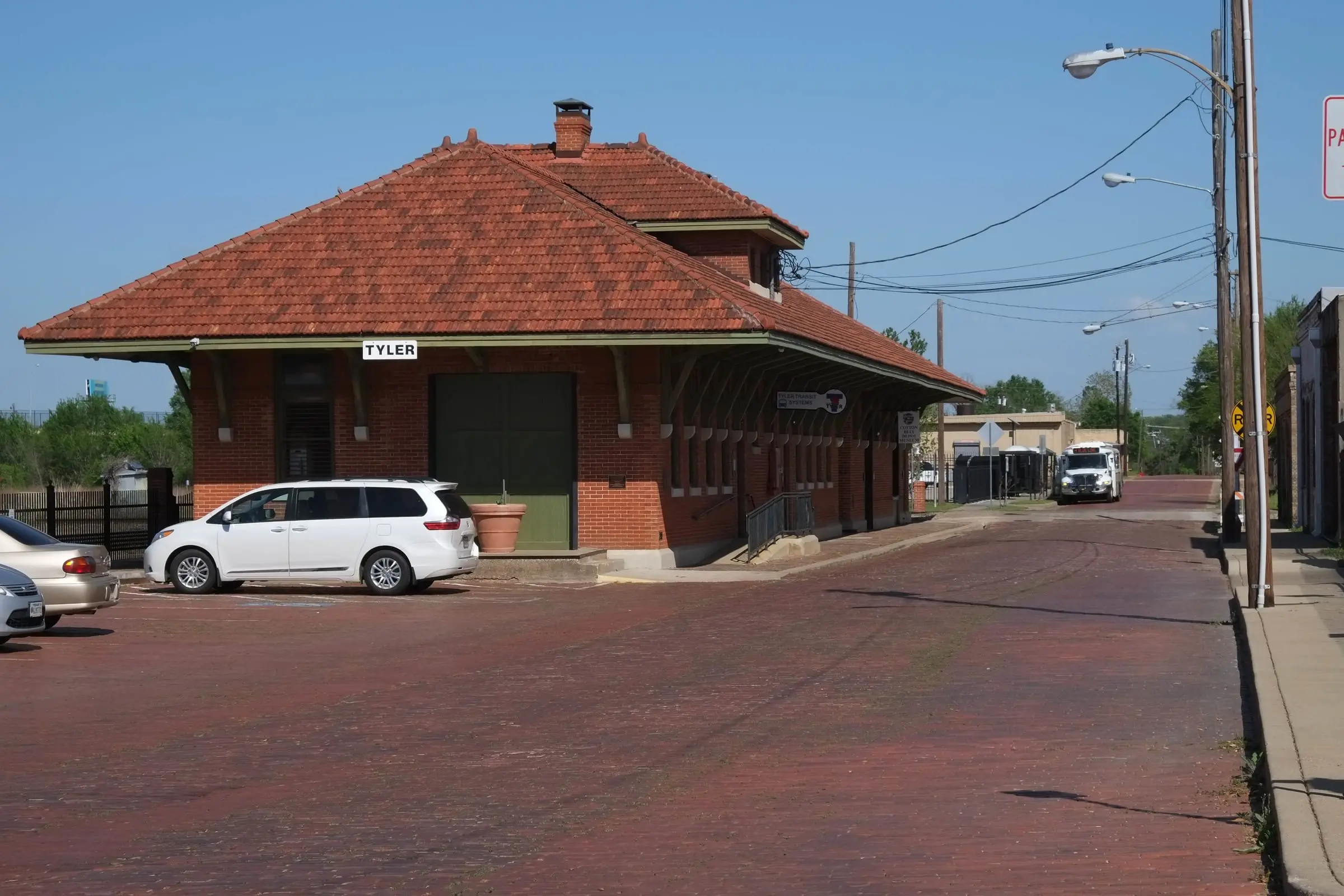
“About one mile of brick paved streets,” says the Sanborn map of February 1912.10 The map
April 10, 1916
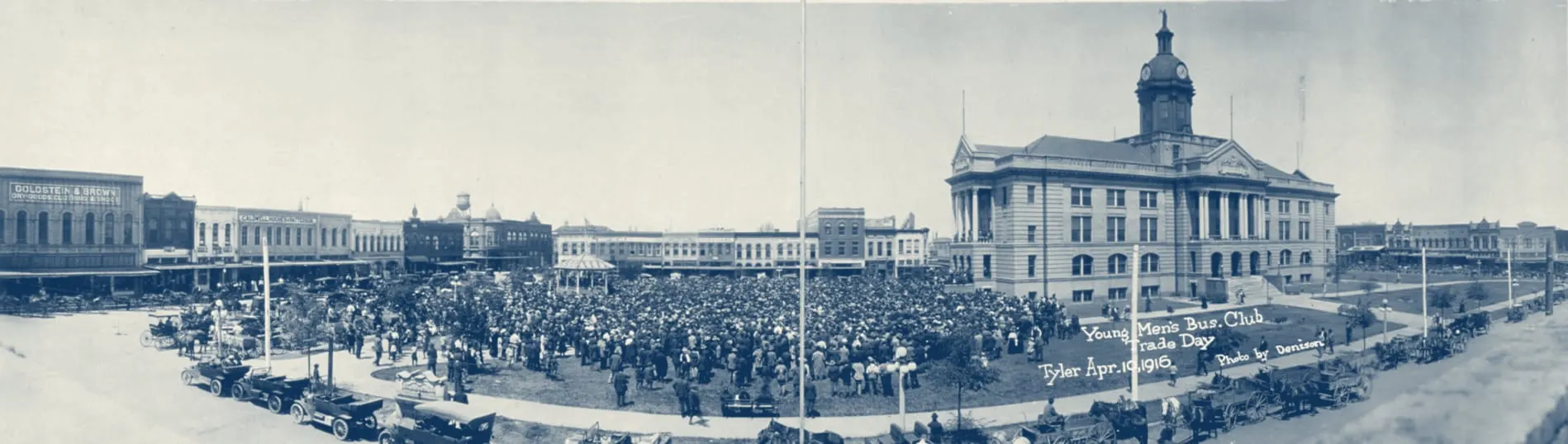
“Streets in business section mostly paved with brick and asphalt,” says the Sanborn map of August 1919.11
September 1923
“…content to pull around in sand and chugholes in dry weather, mudholes in wet weather”
City Manager V. W. Prater, in the Courier Times: “We call Tyler the metropolis of East Texas but still we are content to pull around in sand and chugholes in dry weather, mudholes in wet weather.”12 Of about 130 miles of street, he wrote, about 5 were paved.13
Edna Pollard, newly arrived on South Broadway, remembered it: “Broadway was a wide, dirt street and a mountain of churned up dust rolled over us every time a car passed.”14
1925
Voters passed a bond to build 15 streets on top of the 11 already built, the Tyler Morning Telegraph reported in 2015, and newspapers at the time called it “the largest public improvement project ever launched in the city of Tyler.”15 In the Brick Streets district, red brick began to replace the dirt in the mid-1920s.16
Rudolph Bergfeld, the developer (1855–1930), is credited with “paving Chilton and College with brick … using his own staff labor and funds,” the Azalea district’s nomination says, citing a 1994 article.17
“18½ MILES OF PAVING,” says the Sanborn map of March 1928, without saying of what.18
1930s
In 1935 more than 1,400 families were on county relief. “Most were unskilled laborers and agricultural workers and it was these men who were employed in local WPA and PWA projects,” the Brick Streets nomination says, and the work included paving streets.19 City engineering records credit the Civil Works, Public Works and Works Progress administrations with paving in both brick and asphalt in the mid-to-late 1930s.20 Who laid them
South Donnybrook Avenue, Frazier to Rix, paved in red brick as a Civil Works Administration project.21
East Dobbs Street, in red brick as a Public Works Administration project, in the Charnwood nomination’s reading of the city engineering files; the same nomination’s description has it surfaced within five years of 1925.22
“Paving:—About 37 miles,” says the Sanborn atlas of 1938, again without saying of what.23 The map
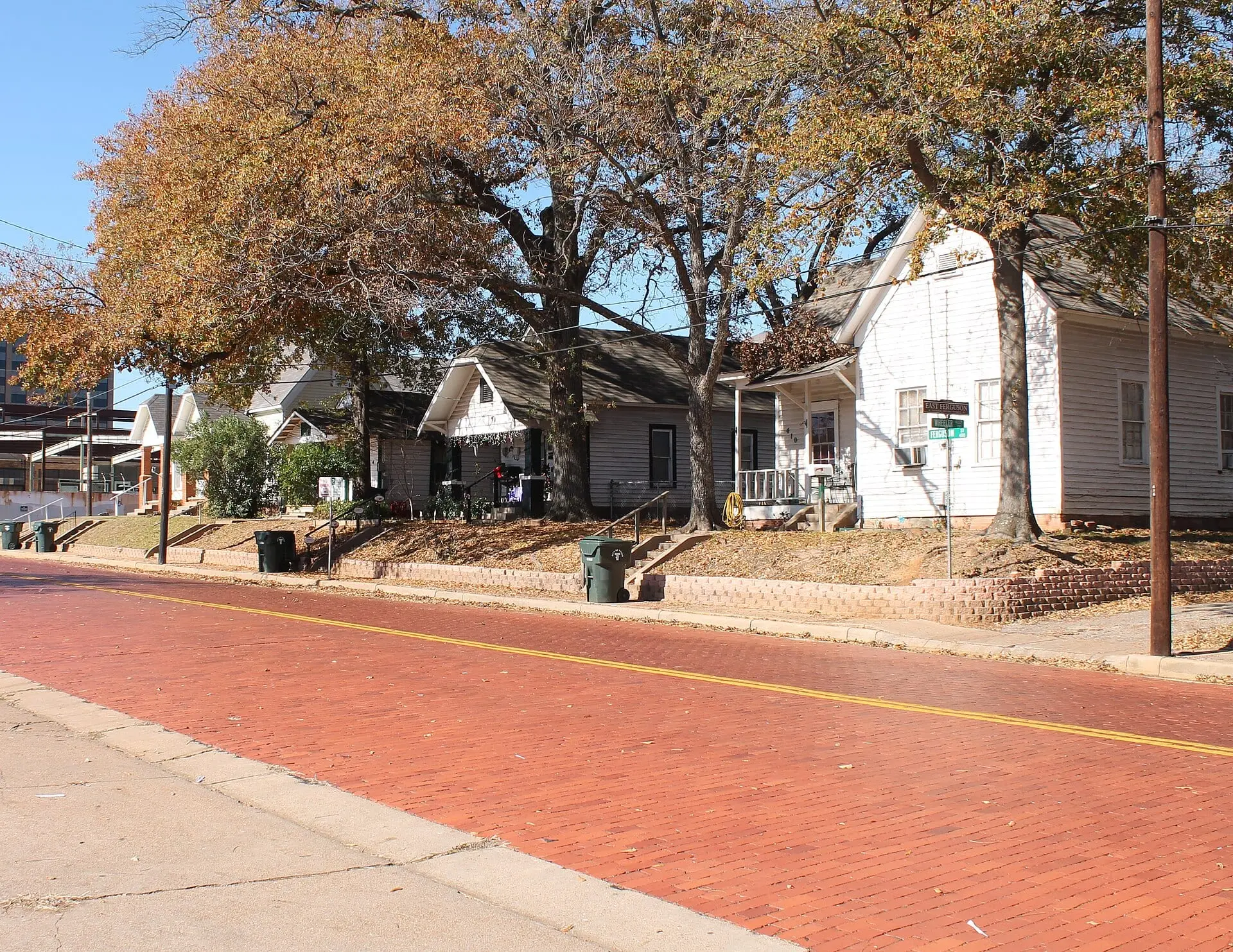
East Ferguson Street is paved, its red brick “still in place” when its district’s nomination was written in 2001.24 Not every street got brick: Short Street, northwest of the square, is paved in asphalt by 1938.25
31 public-works grants, federal or state, applied for and received by the city, brick and concrete paving for dozens of streets among them, and 25 more projects paid for with taxes and property owners’ assessments.26
About 20 miles of brick by about 1942, about seven sixty years later, then 15, 13.8 and 13 in the city’s own counts. The figures come from different documents and nowhere add up; in 2015 the Tyler Morning Telegraph reported brick still lying under the asphalt of numerous old-town streets.29
Charnwood becomes Tyler's first National Register historic district on August 20: 12 blocks and 208 contributing properties, its brick streets among them.36
2004
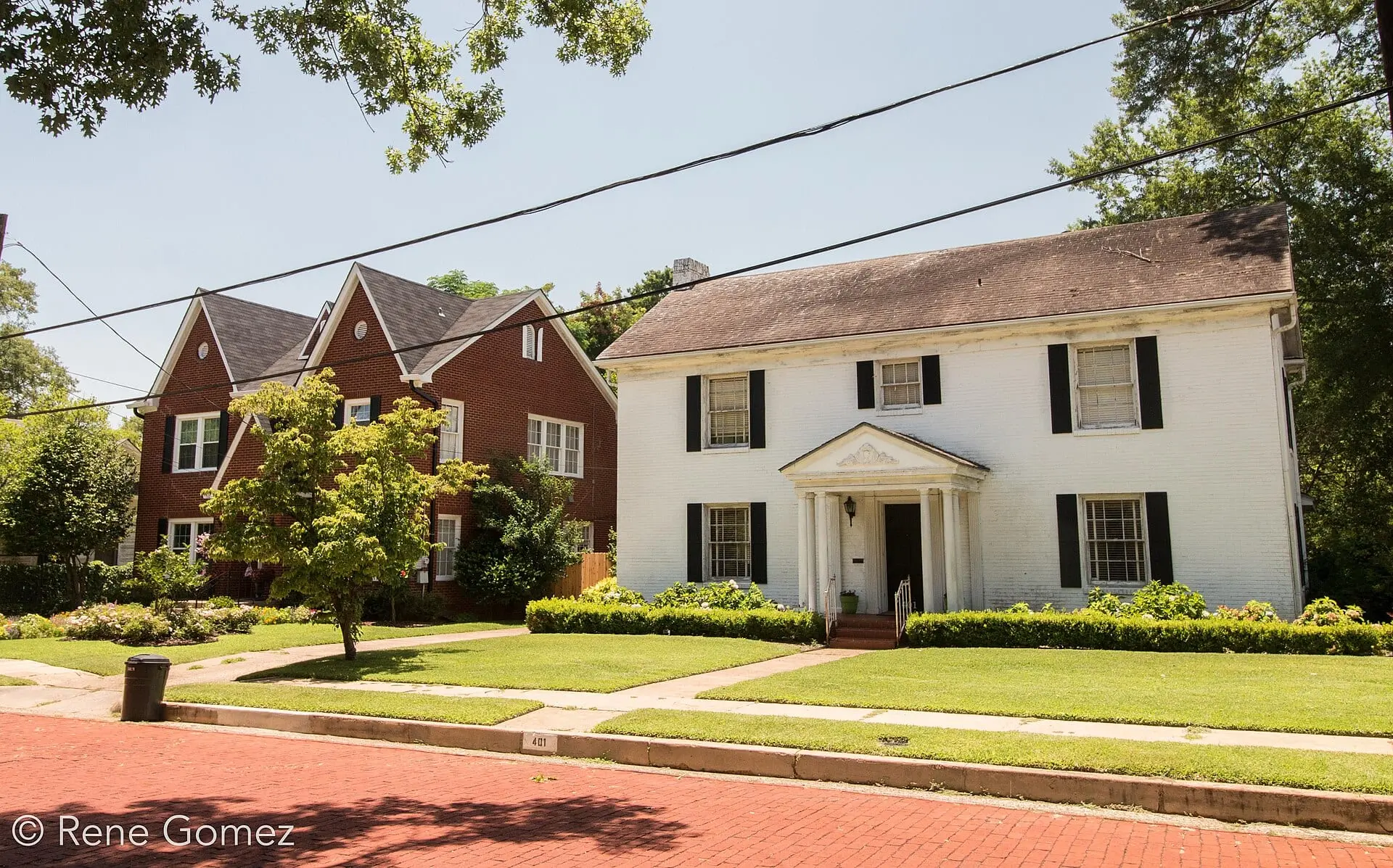
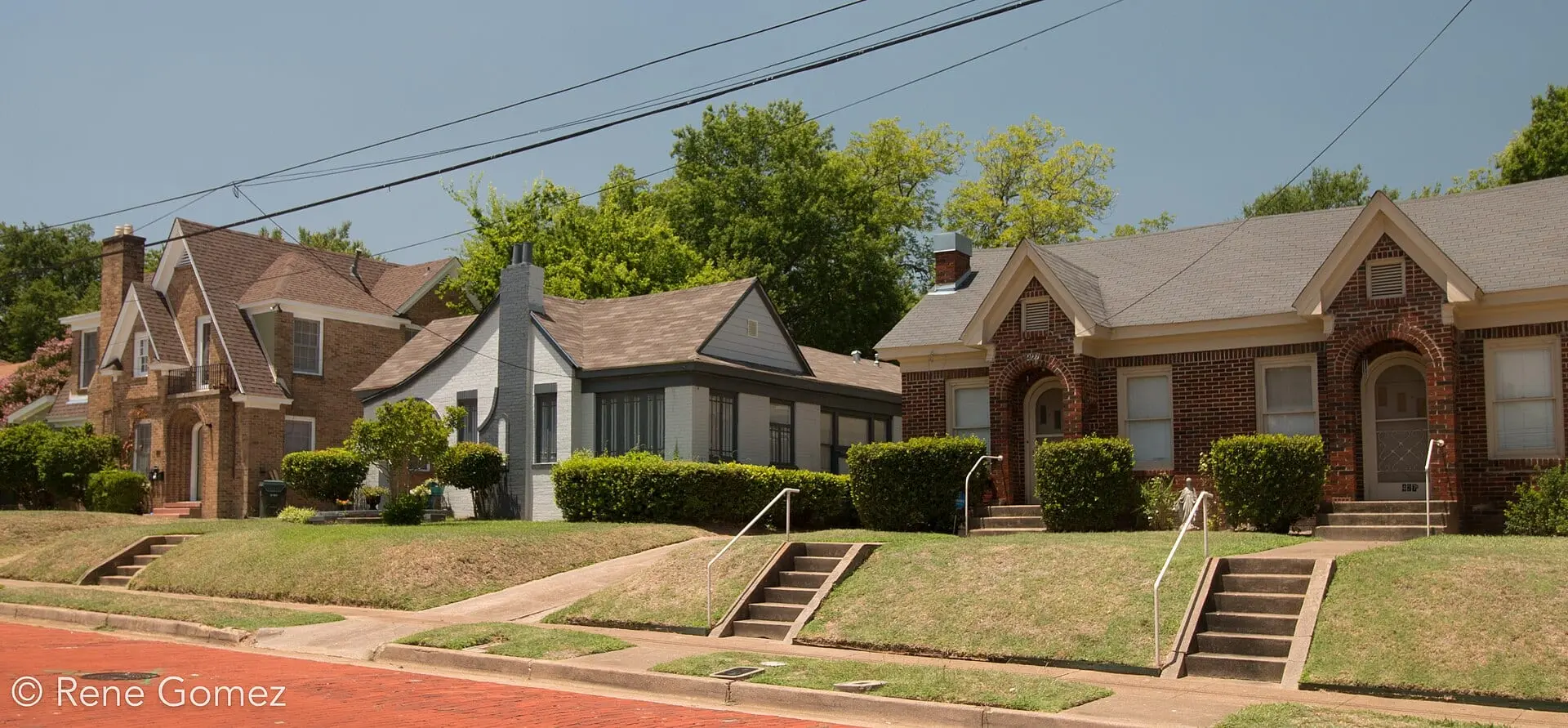
Listed on the National Register on April 28, 2004, in the Texas Historical Commission’s record:37 29 blocks about half a mile south of the original town square, where all or part of 11 of its 14 streets keep their original red brick paving.38
2013
“predominantly by African American men”
City of Tyler planner Heather Nick, telling KLTV who built the brick streets. A city film shows the crews laying bricks assembly-line style in real time.39 Who laid them
2015
A year without a brick crew. In July the council approves putting brick back into 43 utility cuts patched with asphalt.41 In September KLTV reports the Brick Street Operator job frozen in budget cuts, the streets a year without maintenance, and the job to reopen on October 1.42 The crew
Two streets to asphalt. After a storm sewer collapse in 2020, the city decides to rebuild South Thompson Avenue and Barger Street in asphalt and stockpile their bricks for repairs elsewhere.33
33 sites, 21,355 square feet, in the city’s repair list for an $873,961 contract approved in July with Crown Civil Construction.4344
College Avenue taken up. In September, crews take up every brick between Ferguson and Erwin streets for the Downtown Improvement Project, palletize them and store them.45 On September 20, bricks from the project are given away at Broadway and Ferguson; all are gone in about an hour.46 The lift
2026
Every source is listed on Sources and methods.
Note 1. Thurber's brick plant in Erath County, about 75 miles west of Fort Worth, opened in 1897, began making vitrified paving brick in 1898, made only pavers by 1911, and closed around 1930–31. The closing date is approximate: sources give 1930 (the Handbook of Texas, Tarleton’s Gordon Center) or 1931 (the state marker, Tarleton’s Industrious Historian).
Note 2. Demand for brick paving fell as cities chose cheaper asphalt, and the Thurber brick plant closed after the 1929 crash: in 1931 according to the state marker and Tarleton's Industrious Historian, in 1930 according to the Handbook of Texas and Tarleton's Gordon Center.
Note 3. The 2000 National Register survey of Tyler says heavy rains from December 1904 to August 1905 made a mire of the streets, and that four weeks of snow and rain in January 1906 gave them 'a muddy and dilapidated appearance about which frogs are not the only croakers,' a line it cites to the mayor's annual messages.
Note 4. In his 1905 annual message, Mayor John Bonner said Tyler's streets were in the best shape they had ever been, but that total satisfaction would not come until they were paved.
Note 5. According to the city's 2000 multiple-property survey, Tyler's first paving began on July 2, 1906, when contractors Allen and Harrison laid red brick from Thurber, Texas, at railroad crossings. The Tyler Morning Telegraph, citing city data in 2015, puts the first brick streets around 1912, so no single start year is given here.
Note 6. Accounts of Tyler's brick streets disagree on the start: one puts the first brick streets at around 1912, while the National Register nomination dates brick paving to 1906. The two dates are not reconciled in the sources, so neither is given here as the start.
Note 7. Sources disagree on 1907: the Sanborn map of Tyler dated September 1907 says 'streets not paved,' while the 2000 National Register survey and the 2003 Brick Streets nomination say the streets around the courthouse square were paved in 1907 with Mineral Wells brick. Neither source gives a month for the square, so the two may describe different points in 1907. The same 2000 survey dates the first paving, at the railroad crossings, to July 2, 1906.
Note 8. The 2000 survey says paving continued in 1907 and 1908, 'extending pavement as far east on Oakwood Street as the Cotton Belt depot'; the 2003 Brick Streets nomination dates the Oakwood paving from Broadway to the depot to 1908. Neither says what material was used. The depot’s own National Register nomination (2000) says its brick parking area was likely paved when East Oakwood was paved “prior to 1925.”
Note 9. Beside the 1905 Cotton Belt depot, a brick-paved parking area that extends Oakwood Street and a brick sidewalk in front of the depot are contributing features of its National Register listing.
Note 10. The Sanborn map of Tyler dated February 1912 says on its first sheet: 'About one mile of brick paved streets.' It fits neither start date cleanly: the 2000 survey dates the first paving to 1906 and the square to 1907, and city data reported in 2015 puts the first streets around 1912.
Note 11. The Sanborn map of Tyler dated August 1919 says on its first sheet: 'Streets in business section mostly paved with brick and asphalt. Others are in fair condition.' City Manager V. W. Prater wrote in 1923 that only about 5 of Tyler’s 130 miles of street were paved.
Note 12. Prater's 1923 article complained: 'We call Tyler the metropolis of East Texas but still we are content to pull around in sand and chugholes in dry weather, mudholes in wet weather.'
Note 13. In September 1923, City Manager V. W. Prater wrote in the Courier Times that Tyler had about 130 miles of street and only about 5 miles were paved.
Note 14. Edna Pollard, newly arrived and living on South Broadway, remembered: 'Broadway was a wide, dirt street and a mountain of churned up dust rolled over us every time a car passed.' The survey does not date her memory; it sets it in the early 1920s, just before the city manager’s 1923 article.
Note 15. The Tyler Morning Telegraph reported in 2015 that Tyler voters passed a bond in 1925 to build 15 streets on top of a base of 11 already built, and that newspapers at the time called it 'the largest public improvement project ever launched in the city of Tyler' and 'the beginning of new Tyler.' No source we have found gives the bond’s amount or the date of the vote.
Note 16. In the Brick Streets district, portions of many streets that were originally dirt were paved with red brick beginning in the mid-1920s; the nomination dates the district's brick streets to about 1925 to 1940. Districts differ: the Charnwood nomination’s inventory dates its brick streets about 1910 to 1925, earlier than the Brick Streets and Azalea inventories (about 1925 to 1940).
Note 17. The Azalea nomination (2002), citing Tyler Today (Fall 1994), says Rudolph Bergfeld (1855-1930) is credited with 'paving Chilton and College with brick ... using his own staff labor and funds.' The nomination gives no year and no blocks.
Note 18. The Sanborn map of Tyler dated March 1928 says on its first sheet '18½ MILES OF PAVING,' without naming the material. The figure counts all paving, not only brick. In 1923 the city manager counted about 5 paved miles.
Note 19. The Brick Streets nomination says that in 1935 more than 1,400 families were on county relief, that 'most were unskilled laborers and agricultural workers and it was these men who were employed in local WPA and PWA projects,' and that those programs' work included paving streets. The nomination does not tie these men to particular streets.
Note 20. In the mid-to-late 1930s the Civil Works Administration, Public Works Administration and Works Progress Administration paved Tyler streets in both brick and asphalt, according to city engineering records. The nomination calls the PWA the “Progress Works Administration”; the agency was the Public Works Administration.
Note 21. In 1934 South Donnybrook Avenue between Frazier and Rix streets was paved with red brick as a Civil Works Administration project.
Note 22. The Charnwood nomination, citing city engineering files, says East Dobbs Street was paved with red brick in 1938 as a Public Works Administration project (its description section says East Dobbs was surfaced within five years of 1925); East Dobbs is one of three Charnwood streets that keep original brick.
Note 23. The 1938 Sanborn atlas of Tyler says on its report page 'Paving:—About 37 miles,' without naming the material. The line is on the atlas’s report page, not sheet 1, and counts all paving, not only brick. The 2000 survey says about 20 miles of brick streets were completed by about 1942.
Note 24. The East Ferguson nomination (2001) says East Ferguson Street, which runs east from the north side of the courthouse square, was paved by 1938, citing Smith County deed records, 'with the red brick still in place.' The nomination’s text places the street outside the district’s boundary, while its inventory lists it as a contributing brick street.
Note 25. Not every street got brick: the Short-Line nomination says Short Street, about five blocks northwest of the courthouse square, was paved with asphalt by 1938, citing deed records.
Note 26. By 1942 Tyler had applied for and received 31 federal or state public-works grants, among them brick and concrete paving for dozens of streets, and funded 25 more projects with tax money and property-owner assessments.
Note 27. The 2000 survey says about 20 miles of brick streets were completed up to about 1942, when World War II diverted funds and manpower, and that by then residents were no longer routinely choked by dust or mired in mud; the Tyler Morning Telegraph (2015), citing city data, says brick streets were installed through 1947.
Note 28. The Brick Streets (2003) and Azalea (2002) nominations say asphalt replaced brick as Tyler's paving material of choice in the 1950s; the city's figures reported in 2015 put the last brick streets in 1947.
Note 29. The Tyler Morning Telegraph reported in 2015 that some original brick streets had been paved over with asphalt but kept the brick beneath, and that the bricks were the sub-base for numerous old-town streets, including downtown portions of Broadway.
Note 30. Around 2000-2003 the National Register documents said only about seven miles of red brick streets remained in Tyler, much of it in central residential areas. Later city figures are higher: about 15 miles (2013), 13.8 (2015), 13 (2023). The 2015 report notes that brick also survives under asphalt; no source reconciles the counts.
Note 31. In May 2013 city planner Heather Nick told KLTV the brick streets 'were constructed back in the 30's and 40's' and that Tyler had 'about 15 miles of brick streets.' Her dating is narrower than the National Register’s (paving from 1906) and the city’s 2015 figures (through 1947), and her 15 miles differs from 13.8 (2015), 13 (2023) and about seven (2000–03).
Note 32. As of 2015, the city counted nearly 14 miles (13.8) of brick streets made of about 12.6 million bricks, of three types no longer manufactured, so repairs draw on stockpiled bricks. Counts differ by year and source: about 20 miles of brick by about 1942 and about seven in 2000–03 (National Register documents), about 15 in 2013 (a city planner), 13 in 2023 (the city).
Note 33. In May 2022 the city decided to rebuild two brick streets, South Thompson Avenue and Barger Street, in asphalt after a 2020 storm sewer collapse, stockpiling their bricks for repairs elsewhere.
Note 34. In July 2023 KETK reported that the Street Maintenance Department identified areas of 'the 13 miles of brick streets around the City' that need repair, while KLTV's version of the same release said '13 miles of brick street were identified as needing repair.'
Note 35. On October 22, 2025, the council approved a $1,473,686 contract with Crown Civil Construction to remove bricks and lay temporary asphalt along a downtown sewer project that crosses Elm, College and Woldert; the city said the cleaned bricks would be reinstalled, except those from Elm Street between Fannin and College, which had been overlaid with asphalt and would be stockpiled while that stretch got permanent asphalt.
Note 36. The Charnwood Residential Historic District became Tyler's first National Register historic district on August 20, 1999; it covers 12 blocks and has 208 contributing properties, its brick streets among them.
Note 37. The Texas Historical Commission's Atlas gives the Brick Streets district's National Register listing date as April 28, 2004. Historic Tyler, Inc. gives January 2004.
Note 38. The Brick Streets Neighborhood Historic District, listed on the National Register in 2004, covers 29 blocks about half a mile south of Tyler's original town square, and all or part of 11 of its 14 streets keep their original red brick paving.
Note 39. In 2013, City of Tyler planner Heather Nick told KLTV that the brick streets were built 'predominantly by African American men,' and a city film shows the crews laying bricks assembly-line style in real time. The film is described only as showing assembly-line style work, not how the bricks were laid.
Note 40. Because the old bricks are a finite resource, the city requires utility crews to lift them one by one and stack them for city workers to relay, and as of 2015 a dedicated three-person city crew repaired brick streets by hand.
Note 41. On July 14, 2021, the city council approved restoring brick at 43 utility cuts that had been patched with asphalt, a project of nearly $100,000 from the General Fund and Street Commitment Fund.
Note 42. KLTV reported in September 2021 that the city had frozen its Brick Street Operator position in 2021 budget cuts and the streets had gone a year without maintenance because of the pandemic; Mayor Don Warren made a three-man brick crew a priority, the position was to reopen October 1 with the new budget, and the city had another $350,000 with a contractor for larger reconstruction.
Note 43. The city's '2023 Brick Streets Repairs' list attached to KETK's July 26, 2023 story has 35 numbered rows, two of them 'N/A' with no area, so 33 repair sites; their areas add up to 21,355 square feet, the figure KLTV and KETK reported, and the largest was 2,750 square feet at 902 South College Avenue, at the Dobbs and College intersection. The total is the sum of the list’s square-foot column, read from a scanned table; it matches the contract figure KLTV and KETK reported.
Note 44. In July 2023, the Tyler City Council approved an $873,961 contract with Crown Civil Construction to rehabilitate 21,355 square feet of brick streets and rebuild Bois D'Arc Avenue from South Oakwood Street to the railroad tracks; by April 2024, 35 sites had been repaired. The city’s 2023 repair list has 35 numbered rows, two of them marked N/A with no area, so 33 sites with an area to repair.
Note 45. In September 2025, crews took up every brick on College Avenue between Ferguson and Erwin streets for the Downtown Improvement Project, palletized and stored them.
Note 46. On Saturday, September 20, 2025, bricks lifted for the downtown project were given away free at Broadway and Ferguson starting at 7 a.m., and all were taken within about an hour; KLTV reported the bricks were made in Missouri. KLTV does not say how it knows where the bricks were made, or which street they came from. The National Register documents name the Thurber Brick Co., the Mineral Wells Brick Co. and the Tyler Brick Co. as Tyler’s suppliers, so “Missouri” is treated here as unverified.
Note 47. On March 2, 2026, bricks saved from the streets went back down on College Avenue in front of Plaza Tower.
Note 48. Rebuilt College Avenue and Erwin Street reopened to two-way traffic on Wednesday, June 3, 2026, after a ribbon cutting the Friday before. The day is worked out from the article’s June 4, 2026 publication and its “Wednesday.”
Note 49. In mid-July 2026 crews began setting the old bricks back on West Ferguson Street after laying new water and sewer lines and a concrete base.